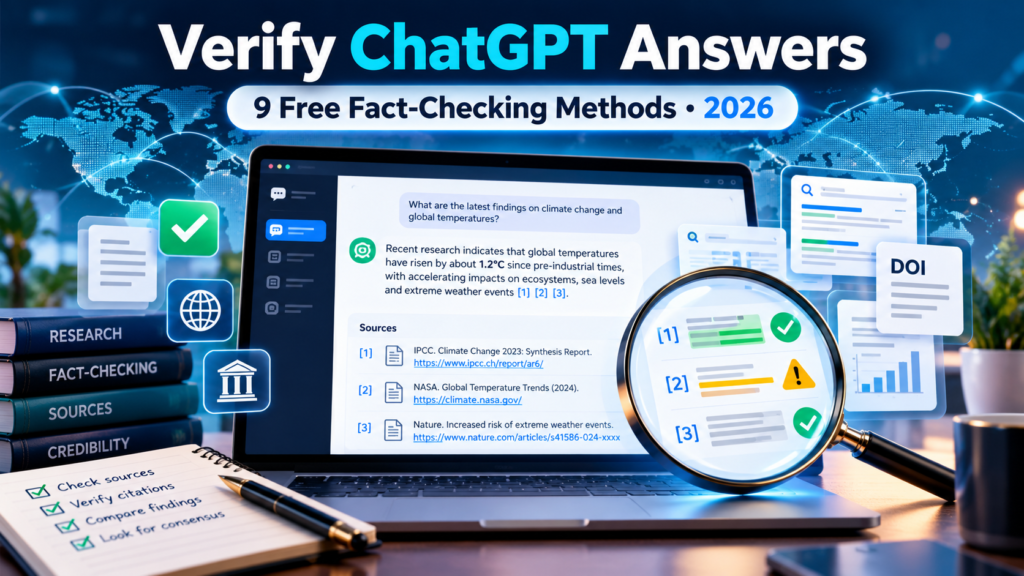
How can you verify a ChatGPT answer before you trust or publish it? Start by separating the answer into checkable claims, finding independent sources, and reading those sources yourself. A confident AI response—even one with numbered citations—does not prove its facts are correct.
This practical 2026 guide explains nine free fact-checking methods for ChatGPT answers and AI-generated citations. The methods work for students, researchers, content creators, journalists, educators, and business professionals across international markets. They also apply to answers from other generative AI services.
Editorial scope: Updated October 2026. All workflows below can be performed with free access to public search engines, source websites, library catalogs, government databases, or public research metadata; some optional specialist platforms offer paid features. Illustrative examples are clearly labeled and are not presented as independent experiments or actual AI failures observed by Vervecta.
How to Verify ChatGPT Answers: The Three-Layer Evidence Test
Every AI answer needs three separate checks. Existence: does the cited source actually exist? Relevance: does it discuss the exact question? Support: does it really justify the specific conclusion, number, or quotation? A real paper cited for the wrong proposition fails the third test just as surely as a nonexistent paper fails the first.
| Question | What you verify | Free starting point |
|---|---|---|
| Does the source exist? | Title, author, date, publication, DOI or official record | Crossref, journal website, library catalog |
| Does it match the claim? | Exact passage, table, research design and scope | Full text, abstract, official document |
| Does independent evidence agree? | Other primary sources and later studies | Google Scholar, PubMed, institutional websites |
| Is it still current? | Updates, corrections, withdrawn guidance or retractions | Publisher notices, current official pages |
For high-stakes decisions involving health, legal rights, personal safety, or substantial money, use appropriate qualified professionals and authoritative current guidance. An AI-generated answer is a starting point, not independent verification.
Why ChatGPT answers and citations can be wrong
Generative language models produce plausible language rather than automatically proving every statement against an authoritative database. Depending on the product, settings, and available tools, the model may generate answers from learned patterns, consult retrieved pages, or cite linked search results. These processes have different limitations, but none removes the need to verify important claims.
Typical failure modes include invented article titles, a real DOI paired with the wrong title, outdated pricing, unsupported percentages, summaries that overstate a study’s findings, and citations that lead to pages discussing a related but different issue. A quotation can also be paraphrased inaccurately or attributed to someone who did not say it.
Watch especially for citation laundering: a believable claim accompanied by several reputable-looking references that do not actually substantiate it. Multiple links can increase an answer’s appearance of credibility without adding real evidence.
OpenAI itself recommends checking important information and using reliable sources. The correct workflow is not to ask an AI system whether it is sure, but to examine evidence outside the answer.
Method 1 — Extract atomic claims before you search
Split a paragraph into the smallest factual statements that can be independently checked. For example, “Tool X has 10 million users, costs $9 monthly, and is available worldwide” contains at least three claims: user count, current price, and geographic availability. Each needs its own source and relevant date.
- Copy the answer into a working note.
- Highlight names, dates, numbers, quoted sentences, “first” or “best” claims, and policy assertions.
- Turn each into one verification question.
- Rank claims by potential harm if wrong.
- Record a separate evidence link and verdict for each claim.
Illustrative example: “A fictional productivity app has 80% accuracy and a free unlimited plan.” Do not search the whole sentence and accept a loosely matching result. Check what “80% accuracy” measures, who tested it, sample size, which app version, and whether “unlimited” still applies to the free tier.
This method is especially helpful with long ChatGPT answers. It prevents a trustworthy paragraph from hiding a single unsupported conclusion inside otherwise accurate context.
Method 2 — Verify the original webpage, not the AI summary
Open the actual source. Check its domain, author, last updated date, publication context, and the sentence or table that supports the claim. A search snippet or an AI-generated citation preview is not a substitute for the document itself.
Use the browser’s find function to search for the exact number or phrase. If the relevant information is in a table, inspect the column definitions, units, population, time period, and footnotes. For policy and pricing claims, use the product’s official help center or pricing page where possible.
Primary versus secondary evidence
A vendor’s own documentation is usually a primary source for its listed plan features, but its marketing claims about competitors may require independent corroboration. A government data release is a primary source for the figures it publishes. A news article summarizing that release is secondary. Both can be useful, but they answer different verification questions.
When the page is missing
A broken or redirected link does not alone prove a citation was invented. Search the exact document title in quotation marks, check the publisher’s catalog, and look for archived or updated versions where lawful and accessible. If the document cannot be located, label the claim unverified rather than assuming the evidence exists.
Method 3 — Confirm academic citations with Google Scholar
Google Scholar helps you locate scholarly articles, books, theses, and citations. It is useful for checking whether a cited work appears in academic search results, but inclusion in Scholar does not automatically prove that a claim is scientifically correct or that a paper has undergone rigorous peer review.
- Search the exact title in quotation marks.
- Compare the author list, publication year, journal or venue, and title spelling.
- Follow a link to the publisher or repository and inspect the original text.
- Look for later research, reviews, and corrections rather than relying only on a paper’s citation count.
If the title does not appear, search a distinctive fragment and the lead author’s surname. Publication titles may vary slightly between preprint and published versions, so investigate differences before deciding a citation is false.
International tip: Research may appear in institutional repositories, local-language journals, or regional databases. An English-only search is not always comprehensive. Use official transliterations and translations where necessary.
Method 4 — Check DOI metadata using Crossref
A Digital Object Identifier (DOI) is a persistent identifier used by many scholarly publications. A DOI that resolves does not automatically validate a quotation or research claim. It confirms an identifier points to a registered scholarly object, whose metadata must still match the citation.
- Copy the DOI precisely, including characters after the slash.
- Open it through doi.org or search the record at Crossref Metadata Search.
- Compare title, first author, year, journal, and publisher.
- Read the article or abstract and locate the actual evidence.
- Look for correction, withdrawal, or retraction notices.
Common trap: An AI output may combine the correct title of one article with the DOI of another. Merely clicking a working DOI link is insufficient. The metadata must refer to the same work.
Not every legitimate scholarly work has Crossref metadata; some use other registration agencies or no DOI at all. Therefore, a missing Crossref record is a prompt for further investigation, not definitive proof of fabrication.
Method 5 — Use PubMed for biomedical claims
For health and biomedical research, search PubMed, a free searchable database of biomedical literature references. A PubMed record provides bibliographic details and may link to an abstract, full text, publisher, or related material.
- Search the quoted study title or identify the author and year.
- Compare the source record with the AI citation.
- Read the abstract’s objectives, design, outcomes, and limitations.
- Check whether the result concerns humans, animals, or laboratory experiments.
- Determine whether the paper establishes causation, association, or merely a hypothesis.
Pay special attention to a study’s sample size and patient population. Results from one region, age group, or treatment setting cannot automatically be generalized to everyone. A systematic review or official clinical guideline may be more appropriate for an overview, but it too must be current and interpreted carefully.
Important: Presence in PubMed is not a blanket quality endorsement. Do not use ChatGPT or this checklist to self-diagnose or change treatment without competent medical advice.
Method 6 — Cross-check numbers against original public data
Specific percentages are persuasive and particularly easy to misinterpret. When ChatGPT reports inflation, population, employment, internet adoption, carbon emissions, or software market share, trace the figure to the data owner and note its measurement period.
Useful primary data sources include World Bank Open Data, OECD Data, Eurostat, and national statistical offices. Choose the source that actually publishes the relevant dataset.
Seven questions for any percentage
- What precisely is measured?
- What is the denominator?
- Which country or region?
- Which date or year?
- Is the figure estimated, revised, or provisional?
- Is the comparison nominal, real, per person, or adjusted?
- Does the cited table contain the value claimed?
Illustrative example: A statement that “AI adoption grew 50%” is ambiguous. Growth from 10% adoption to 15% adoption is a 50% relative increase, but only a five-percentage-point increase. Distinguishing the two changes the meaning substantially.
Method 7 — Investigate corrections, retractions, and newer evidence
Even a real published paper can later be corrected or retracted. Look on the publisher’s page for linked notices, expressions of concern, updated editions, or replacement publications. Crossref’s public metadata ecosystem also contains information relating to retractions and updates; its official website provides documentation and discovery resources.
A 2019 report may have accurately described a situation then while being inappropriate support for a 2026 claim about current pricing, regulation, or software functionality. Old evidence is not necessarily wrong, but its relevance to a present-tense claim must be examined.
Where research is disputed, compare a range of sound primary studies and syntheses. Do not present one surprising result as scientific consensus. Also avoid the opposite mistake: treating any disagreement as evidence that all viewpoints are equally supported.
Method 8 — Use research discovery tools as a second check
Specialized tools such as Scite, Consensus, and Elicit can help locate research, explore papers, and examine how evidence relates to a question. Their plan limits and available features change, so do not assume any particular paid feature is free.
Use them as discovery and triage tools, not substitutes for reading cited studies. A research summary may leave out crucial context, incorrectly collapse different study designs, or overlook newer papers.
A practical workflow
- Start with a precise question, including target population and date range.
- Collect relevant original papers using free public discovery methods.
- Where available, use specialized tools to identify contrasting findings and relevant follow-up work.
- Read the methods and conclusions in the original studies.
- Document the reasons for accepting, rejecting, or qualifying each claim.
For a broader introduction, see Vervecta’s AI research assistants comparison. This guide focuses specifically on verification rather than ranking research assistants.
Method 9 — Triangulate independent sources and label uncertainty
The final check is to seek genuinely independent confirmation. Three websites repeating the same press release count as one chain of evidence, not three independent investigations. Identify whether articles cite the same original study, dataset, or corporate announcement.
When possible, triangulate a primary source, independent reporting or analysis, and a current authoritative record. If they disagree, document the precise disagreement: geography, timeframe, definition, methodology, or update history.
Use a straightforward status system:
| Status | Meaning | Editorial action |
|---|---|---|
| Verified | Relevant primary evidence directly supports the wording | Publish with the source and date |
| Qualified | Broadly supported but with important limits | Add population, date, and caveats |
| Unverified | Adequate evidence was not located | Hold or rewrite as uncertainty |
| Contradicted | Reliable evidence conflicts with the statement | Correct it or remove it |
| Outdated | Once valid, now superseded | Replace with current evidence |
This explicit evidence trail is more honest and more useful to international readers than an unsupported “fact-checked” badge.
A worked example: auditing an invented AI citation
The following case is fictional for teaching purposes; it is not a genuine ChatGPT output or a real bibliographic reference.
“A 2025 global study found that 82% of students trust AI citations without checking them. Source: Global AI Citation Trust Report, International Learning Institute, DOI: 10.xxxx/example.”
Step A: Extract the atomic claims: year 2025, a global student sample, 82%, named publisher, titled report, and a DOI. Step B: Search the exact title and organization name. Step C: Try resolving the identifier; the example identifier is deliberately not a valid scholarly citation. Step D: If a similar study appears, compare its sample, wording, and percentage rather than substituting it automatically. Step E: If the named source cannot be located, mark the assertion unverified and do not publish the 82% figure.
This exercise demonstrates why an answer can sound research-based while offering no usable evidence. Notice that searching for a plausible alternative number would not rescue the original claim: the correct response is to disclose uncertainty.
An international newsroom, student, and business workflow
For students and researchers
Keep a citation log containing full title, authors, DOI or stable URL, date accessed, and the exact passage you rely on. Follow your institution’s academic integrity rules on AI assistance. Cite the source you actually read, not a reference copied from ChatGPT without opening it.
For journalists and content publishers
Verify each named person, allegation, quote, and numerical assertion independently. Use contemporaneous records, public filings, original interviews, and authoritative official sources where appropriate. Distinguish “reported,” “confirmed,” and “alleged,” and record corrections transparently.
For software buyers and affiliate publishers
Check the vendor’s official pricing, trial limits, supported countries, cancellation terms, commercial license, and feature documentation. Date every pricing comparison. Do not portray marketing language or AI-generated estimates as independently tested performance. Any affiliate relationship should be disclosed clearly under applicable rules.
For global readers
Be careful with units, currencies, time zones, legal jurisdictions, and translated publication titles. A US regulatory page does not automatically describe requirements in Canada, India, the EU, or Australia. Specify country and effective date whenever location changes the answer.
Reusable fact-checking worksheet
Copy this mini-template into a document or spreadsheet before relying on an AI-generated response:
| Field | What to record |
|---|---|
| Claim | One concise checkable sentence |
| Risk | Low / medium / high if wrong |
| AI citation | Exact quoted reference or URL |
| Primary source | Publisher, stable URL/DOI and accessed date |
| Evidence excerpt | Relevant passage or table and its context |
| Independent check | Separate publication or original dataset |
| Verdict | Verified / qualified / unverified / contradicted / outdated |
| Correction | Final wording with caveats |
In an organization, assign an owner and review date for high-risk claims. The worksheet creates a reproducible editorial trail without requiring expensive software.
Seven red flags worth investigating
- A DOI that resolves to a different article. The link works, but the metadata does not match the reference.
- Precise numbers without units or timeframe. “Up 67%” is meaningless without the baseline and context.
- Quotes with no page, transcript, or original publication. A credible-looking attribution can still be invented.
- An older source for a rapidly changing 2026 claim. Product prices, platform policies, and rules may have changed.
- Only one source for an extraordinary conclusion. Seek independent confirmation proportionate to the claim.
- A real paper summarized beyond its findings. Correlation, preliminary work, or narrow populations are presented as universal facts.
- Repeated identical wording across different sites. Several URLs may trace back to one unsupported announcement.
Common mistakes when verifying AI answers
Asking the AI to confirm itself
“Are you sure?” may produce another confident but unsupported response. Request the original source and then verify it outside the model.
Trusting a link because it uses HTTPS
HTTPS indicates encrypted transport; it does not certify factual quality, editorial independence, or the accuracy of the page’s claims.
Checking only a headline
A headline can simplify, sensationalize, or omit a key condition. Read the relevant section, methods, or data table.
Confusing citation count with truth
A highly cited paper can still be criticized, corrected, or applied outside its proper context. Examine the evidence, not just popularity.
Treating every disagreement as an error
Different statistics may measure different populations or periods. Resolve the definitions before discarding one result.
Ignoring original language and publication context
Automatic translation can erase important nuance in legal provisions, research limitations, or quoted remarks. Consult a trusted translation or an expert when meaning is consequential.
Frequently asked questions
Can ChatGPT fabricate citations?
Yes. AI outputs may include non-existent references, inaccurate bibliographic details, or real sources that do not support the claim. Verify authors, titles, identifiers, and the source passage.
How do I tell if a DOI is fake?
Try resolving it through doi.org and compare metadata with the claimed paper. Failure to find one identifier is not proof that the research does not exist: check the journal, author, publisher and other registration systems.
Is Google Scholar enough to verify a research claim?
No. It can locate relevant publications, but you still need to read the original material, judge the evidence, and check for later corrections or contradictory findings.
Are AI citations automatically more reliable when browsing is enabled?
Browsing can improve access to current sources, but an answer may still misunderstand or overstate what a linked page establishes. Check the original source directly.
What free tools should a student start with?
A web search engine, Google Scholar, Crossref Metadata Search, public library resources, and relevant subject databases are sensible free starting points. PubMed is useful for biomedical literature.
Can Scite, Consensus, or Elicit replace reading papers?
No. They can assist discovery or analysis, but important conclusions should be checked against original studies and their limitations. Review current free and paid feature restrictions.
What if a research paper is paywalled?
Check legitimate repositories, institutional access, public abstracts, author-posted versions, or the library. Do not claim to have verified the full study if you could access only a summary.
How do I verify a ChatGPT quote?
Search the exact phrase and confirm it in a primary transcript, official publication, recording, or directly attributable statement. If only secondary references exist, qualify the attribution.
Does an AI-generated answer need citations for every sentence?
Not every explanatory sentence requires a footnote, but material factual claims, quotations, numerical assertions, legal or medical statements, and contested propositions should have evidence appropriate to their importance.
Can I use this process for Gemini or Perplexity?
Yes. The existence–relevance–support framework applies regardless of which AI system generated the answer.
Final checklist and editorial verdict
Before you rely on an AI answer, confirm that the critical claims have been isolated, primary sources identified, metadata matched, relevant passages read, dates checked, and contradictions considered. Mark unresolved statements as unverified and never invent a missing citation to make an article look complete.
Bottom line: The most effective fact-checking approach is not a single magical detector. It is a transparent, repeatable verification process that treats AI-generated text as a draft and independent evidence as the authority. For related research workflows, explore Vervecta’s AI research assistants guide, AI tools for students, and AI writing tools comparison.
Official resources for further reading
- OpenAI Help Center — limitations and guidance for ChatGPT.
- Google Scholar — academic publication discovery.
- Crossref Metadata Search — bibliographic metadata.
- DOI resolver — persistent identifier lookup.
- PubMed — biomedical literature references.
- World Bank Open Data — public data.
- OECD Data — comparative datasets.
- Eurostat — European statistics.
- Crossref — documentation and metadata infrastructure.
Disclosure: This article is an educational verification workflow, not a substitute for specialized professional review. No proprietary benchmark or first-hand audit of commercial research products is claimed.